skip to main |
skip to sidebar
…
Rating 2¾
Written by Louis Marks
Directed by David Maloney
Starring Tom Baker (The Doctor), Elisabeth Sladen (Sarah Jane Smith), Frederick Jaeger (Sorenson), Ewen Solon (Vishinsky), Prentis Hancock (Salamar), Michael Wisher (Morelli), Graham Weston (De Haan), Louis Mahoney (Ponti), Terence Brook (Braun), Tony McEwan (Baldwin), Haydn Wood (O’Hara) and Melvyn Bedford (Reig)
 The TARDIS responds to a distress call from Zeta Minor, the most distant planet in the known universe, where the Doctor and his companion Sarah Jane discover the apparently abandoned base of a geological expedition. A military ship has also answered the distress call and the Doctor and Sarah Jane become suspects for the unexplained deaths of several of the expedition crew. Only Professor Sorenson remains alive and the Doctor realises he has been tampering with antimatter in his bid to discover alternative sources of energy to save his people, whose Sun is dying.
…
‘Planet of Evil’, a serial broadcast in four 25-minute episodes between 27 September and 18 October 1975, has always stuck in my memory. I am not sure why. Perhaps because it is clearly based on the classic 1956 film ‘Forbidden Planet’, a real favourite of mine, with a bit of ‘Dr Jekyll and Mr Hyde’ thrown into the mix. Maybe because this was one of the classic periods of Doctor Who, with the most popular and successful Doctor, Tom Baker, and one of the most popular companions, Sarah Jane Smith, played by Elisabeth Sladen.
 Elisabeth Sladen played this role from ‘The Time Warrior’ at the start of the final season featuring the third Doctor, played by Jon Pertwee, in December 1973, until ‘The Hand of Fear’ in October 1976, the second serial in Tom Baker’s third season. She made a subsequent appearance in ‘The Five Doctors’ in 1983 and in the aborted 1981 spin-off ‘K9 and Company’, before returning in 2006 for a guest appearance in ‘School Reunion’ in the revived series. This led to the successful spin-off ‘The Sarah Jane Adventures’, which has so far run for three seasons, with two more confirmed by the BBC.
Is ‘Planet of Evil’ memorable? Well, I don’t think it ranks amongst the very best Doctor Who serials from the classic series, but I love nearly all Doctor Who and this is a minor gem, even if it does rather fizzle out in the final episode. It is not original by any stretch of the imagination, but it is constructed with some degree of flair. The message can perhaps best be summed up by something the Doctor says to Professor Sorenson: “You and I are scientists, Professor. We buy our privilege to experiment at the cost of total responsibility.” It is a theme that has been explored over the course of the series time and time again.
The sets are what they are and anyone with any knowledge of Doctor Who knows not to expect state-of-the-art special effects. The spacecraft is rather threadbare, to say the least, but the alien jungle landscape of the planet Zeta Minor is not entirely bereft of charm.
Tom Baker had an odd lazy approach to his acting, almost disinterested, which somehow seemed to work perfectly. It gave his Doctor a slightly disengaged air, often one of amused and slightly superior intellectual curiosity. I recall that he was sometimes compared to Harpo Marx and there is occasionally a degree of uninhibited anarchy about him.
‘Planet of Evil’ perhaps has not quite lived up to my memory of it all these years later, but I still enjoyed it very much.
Review posted 17 June 2010
…
...
Rating 2¾
Written by Gareth Roberts
Directed by Catherine Morshead
Starring Matt Smith (The Doctor), Karen Gillan (Amy Pond), James Corden (Craig Owens), Daisy Haggard (Sophie), Owen Donovan (Steven), Babatunde Aleshe (Sean), Jem Wall (Michael) and Karen Seacombe (Sandra)
 “All I have to do is pass myself off as an ordinary human being. Simple. What could possibly go wrong?”
The TARDIS arrives unplanned in Colchester, but when the Doctor steps out it immediately dematerialises, leaving him separated from his companion Amy. The Doctor turns up on the doorstep of Craig Owens, announcing that he is the new lodger and producing a small brown paper carrier bag full of money. Something very strange is happening upstairs that is preventing the TARDIS from materialising and the Doctor needs to find out what it is, but he is also not blind to Craig and his friend Sophie and the obvious unspoken feelings they have for one another.
...
 We arrive at episode eleven. The next two episodes will see the latest season reach its climax and be brought to a close, so ‘The Lodger’ might be described as the calm before the storm. This is an episode that perhaps could be equated to ‘Love and Monsters’ in season two of the revived series or ‘Blink’ in season three. From comments I have read, some fans are critical of ‘The Lodger’ because they say it is not Doctor Who. When the Doctor should be concentrating on the mysterious and disturbing events taking place upstairs, the disappearance and we assume death of innocent people, he is out playing football or fooling around at the office where Craig works. This I feel completely misses the point and assumes that Doctor Who is a soulless sci-fi series with no humour and no interest in people and the minutiae of human drama. ‘The Lodger’s is a comic diversion, the story of two people who are in love with one another but find it impossible to openly express their true feelings. The science fiction element, the strange events at the top of the stairs, is not entirely without relevance, but it is to some degree incidental.
‘The Lodger’ is an episode that, after one viewing, I think starts brightly, has countless funny and memorable moments, but perhaps does not quite add up to the sum of its parts. However, it’s affectionate and warm-hearted and benefits from a pitch-perfect performance by Matt Smith, who has proved himself to have exquisite comic timing. There are several references back to the “classic series”, a now familiar refrain in this fifth season of the revived show. When asked if he plays football, the Doctor says, “Football? Is that the one with the sticks?” It’s a funny line in itself, coming in an episode that coincides with the start of the 2010 World Cup, but also a clever reference back to the fifth Doctor, who is incidentally the favourite of executive producer and head writer Steven Moffitt.
 From many of the comments I have read about this episode it does seem that I was not alone in being dubious of the involvement of James Corden, who would clearly seem to be a love or hate figure, perhaps more so after his recent childish spat with the actor Patrick Stewart. And like many others, I was pleasantly surprised to discover that he gives a restrained and likeable performance as the sweet natured and lovelorn Craig.
I enjoyed ‘The Lodger’ very much and it might just become more of a favourite in the fullness of time. For now it was a pleasant diversion that does not count amongst the best episodes of this season.
‘The Lodger’ was written Gareth Roberts, who has written several other episodes of the series and many episodes of its spin-off show ‘The Sarah Jane Adventures’. His previous work includes the soap operas ‘Emmerdale’ and ‘Brookside’, as well as the Vic Reeves and Bob Mortimer revival of ‘Randall & Hopkirk Deceased’, which starred the longest serving and most successful Doctor of them all, Tom Baker, in a supporting role.
Review posted 13 June 2010
...
...
Rating 3¾
Written by Richard Curtis
Directed by Jonny Cambell
Starring Matt Smith (The Doctor), Karen Gillan (Amy Pond), Tony Curran (Vincent Van Gogh), Bill Nighy (Dr Black), Nik Howden (Maurice), Sarah Counsell (Waitress) and Nik Howden (Mother)
 The Doctor takes Amy to the Musée d’Orsay in Paris to visit the Vincent Van Gogh collection. She mentions that he has taken her to many fabulous places recently and asks why he is treating her to such special attention, but he brushes aside her suspicious questioning. When the Doctor notices a malevolent face in Van Gogh’s painting of The Church at Auvers, he and Amy travel backwards in time in the TARDIS to find out what it was that Van Gogh had painted and discover that he is battling a giant invisible alien creature known as the Krafayis.
...
I have been deliberately keeping myself as uninformed as possible about each new episode of Doctor Who, wanting to be surprised by developments in the continuing storyline. Sometimes I have failed, such as the last episode, when I inadvertently discovered in advance that something terrible was going to happen and guessed what it would be. All I knew about ‘Vincent and the Doctor’ in advance of watching it was what I had seen in the trailer at the end of the previous week’s episode and, subsequently, the knowledge that it was written by Richard Curtis, whose work, generally speaking, I am not a fan of. I assumed it would be a jokey throwaway, perhaps along the lines of ‘The Shakespeare Code’ in the third season of the revived series. I was not expecting what we actually got.
 On the face of it, ‘Vincent and the Doctor’ is a typical Doctor Who episode. There are several self-referential allusions to the past. Not for the first time in this latest season, there is a visual reference to the first Doctor (William Hartnall). The character played by Bill Nighy, an art expert conducting a tour of the Van Gogh collection, can be related back to John Cleese and Eleanor Bron, the art snobs seen in the Louvre in the famous 1979 Doctor Who serial ‘City of Death’, which was co-written by Douglas Adams.
The invisible creature, a kind of giant rooster, is nothing to get excited about and is, in itself, the least interesting aspect of the episode. However, it serves a purpose, one that I suppose draws on the influence of the classic 1956 science fiction film ‘Forbidden Planet’. In that film, the character Dr Morbius inadvertently creates a gigantic invisible monster with the power of his id. The Krafayis is not created by Van Gogh, but it can be viewed as a kind of manifestation of his illness, not least because ultimately, when it is too late, it is realised that the creature was fearful and disorientated and lashed out for that reason. The action here takes places just months before Van Gogh would commit suicide, a victim of severe depression that had haunted him for much of his life. In the episode we see his extreme mood swings, from great elation to soul-destroying melancholia.
 Van Gogh is initially hostile towards the Doctor, although less so towards Amy. However, he craves companionship and people he can talk to who understand him. He soon begins to respond to them and a change can be seen in his manner, until in one tremendous scene we discover how desperately lonely he is. When he realises that the Doctor and Amy will soon leave him he immediately becomes angry and sinks into deep despair. It’s beautifully done, dealt with in a subtle and responsible way.
The episode contains many clever and nicely observed touches. Van Gogh, a native of the Netherlands, speaks in a broad Scottish accent. When the Doctor and Amy first encounter him he observes that Amy has a Dutch accent, because that is how he hears her. We, the audience, are likewise hearing Van Gogh the way that Amy, who is Scottish, does. Van Gogh, because of his acute awareness of the fragility of the mind, is able to recognise Amy’s inner sadness, something she herself is unaware of. Her conscious memory of Rory, her dead fiancé, has been erased, but not it seems her sub-conscious memory.
 The episode possibly bludgeons us a little unnecessarily with the fact that Van Gogh was a genius whose paintings were unheralded and unsuccessful in his lifetime and that he was increasingly frustrated that he was unable to reproduce on canvas what he saw in the world around him and in his own head. However, this is leading up to the scene in which the Doctor and Amy bring Van Gogh forward in time so that he can see his work on display in the Musée d’Orsay and hear for himself the enormous admiration and wonder it inspires in people. This scene, complete with cheesy musical accompaniment, courtesy of a song by the dreadful Athlete, could so easily have been mawkish over-sentimental drivel, but against all the odds it works beautifully, in no small part due to the terrific performance by Tony Curran.
The closing scene, also, in which Amy insists that she and the Doctor return to the Musée d’Orsay after taking Van Gogh back to his own time, is effective and cleverly conceived. She expects to find new paintings, even greater works that Van Gogh would have created had he not killed himself when he did. Instead, she discovers that nothing has changed. Those few days of happiness and the renewal of spirit that Van Gogh experienced in the company of the Doctor and Amy were just that, a fleeting respite from his spiralling despair and mental illness.
 The only jarring note for me was the “To Amy” message now appended to the painting of Still Life: Vase with Twelve Sunflowers. It was enough for us to suppose that Amy had inspired Van Gogh to create this celebrated painting, but this unnecessary addition made it became too artificial and pulled me away from the narrative.
This fifth season of the revived series is increasingly proving to be one of the best yet. It is certainly, for me, a return to the brilliance of the first two seasons back in 2005 and 2006. My rating for each episode has been deliberately on the low side. I do not want to fall into the trap of awarding a “5” based on my initial reaction after watching an episode once or twice at most. However, ‘Vincent and the Doctor’ is an episode that quite possibly will, in the fullness of time, prove to be just that.
Review posted 8 June 2010
...
...
Rating 2
Directed by Christopher Nolan
Written by Christopher Nolan and David S Goyer, based on the comic books by Bob Kane and Bill Finger
Starring Christian Bale (Bruce Wayne / Batman), Michael Caine (Alfred Pennyworth), Liam Neeson (Henri Ducard), Katie Holmes (Rachel Dawes), Rutger Hauer (William Earle), Gary Oldman (Sgt James Gordon), Cillian Murphy (Dr Jonathan Crane / The Scarecrow), Tom Wilkinson (Carmine Falcone), Mark Boone (Detective Arnold Flass), Linus Roache (Thomas Wayne), Sara Stewart (Martha Wayne), Ken Watanabe (Ra’s al Ghul) and Morgan Freeman (Lucius Fox)
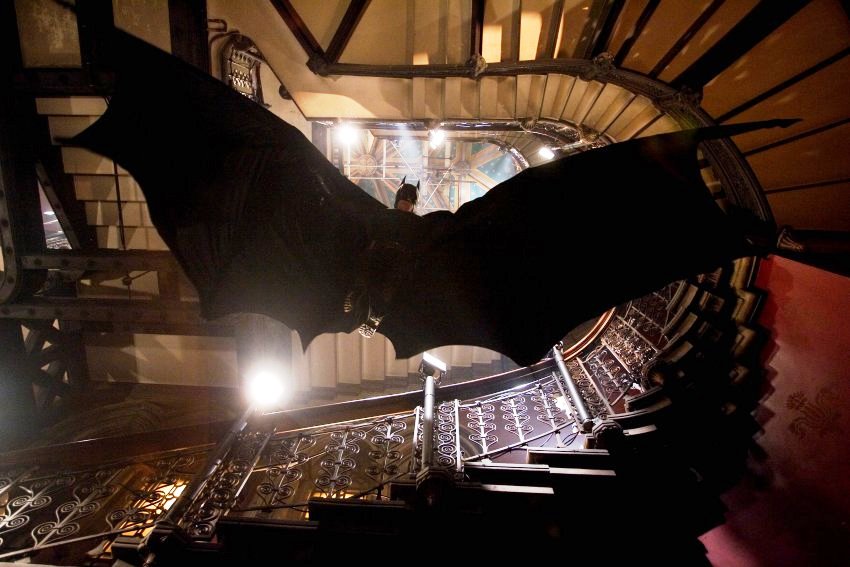
 Young Bruce Wayne witnesses the murder of his parents. He returns to Gotham City as an adult, intent on revenge against the killer, who is then assassinated before he can do so. He decides to immerse himself in the criminal underworld to try to understand the motivation to do evil and ends up in a hellish prison. He escapes and encounters Henri Ducard, who leads him to Ra’s al Ghul and the League of Shadows, where he undergoes rigorous training, intended to rid him of his fear and turn him into a fearless fighter. He is told of a plan to purge Gotham of evil by destroying the city, but he refuses to have anything to do with it. He returns to Gotham and with the help of Alfred Pennyworth, the loyal Wayne family butler, he sets about creating an alter-ego, Batman, to help rid the city of corruption.
...
 I should start by mentioning that ‘Batman Begins’ has an 85% fresh rating at Rotten Tomatoes from 254 reviews, 215 of those reviews judged to have been favourable.
It took me three attempts to watch the whole of the film. I all but gave up after the first 45 minutes or so, having become increasingly irritated by the relentless ninja nonsense. I later returned to the film for a second try, picking it up where I had stopped watching. Once the action moved back to Gotham and Batman made a first appearance, things improved marginally, but still I grew restless within the hour. I came back to the film the next day to finish watching it, but I had largely lost interest before the end came.
So, what is wrong with the film? Probably nothing very much, but I just didn’t like it. Much was made of the fact that the film and directed and co-written by Christopher Nolan and clearly it has been made with some skill. It was, we were repeatedly told, a much darker interpretation of Batman, which I guess is true if by dark they mean silly. I found the comic-book fight scenes excruciatingly boring, but that is something I knew to expect, because it has increasingly become a problem in these types of blockbuster films.
 Most troublesome, though, was my dislike of Christian Bale’s performance in the lead role. I had not previously seen a Christian Bale film and I was undoubtedly guilty of some bias because of the spectacularly appalling rant he was responsible for on the set of ‘Terminator Salvation’. Irrespective of the excuses that have been made for his behaviour, and his own subsequent apology, he is quite clearly an arsehole. However, it is tempting to suspect that this kind of behaviour is commonplace and Bale is only really guilty of having his outburst made public. It should not necessarily affect judgement of his acting. I was just left cold by his take on Batman. I didn’t like Katie Holmes either, although I have seen performances in other films and not come away with any negative opinions. She was replaced by Maggie Gyllenhaal in the sequel, ‘The Dark Knight’. Cillian Murphy seemed to be channelling the spirit of Christian Slater, which I found rather off-putting, because it was all I could focus on whenever he was on the screen. Having said that, the concept of the Scarecrow was quite effective.
 The remainder of the lead cast did exactly what you would expect from them and this was probably the saving grace for me. I was happy enough to watch Michael Caine and Rutger Hauer and rather impressed by Liam Neeson, although the true identity of his character was blatantly obvious to me right from the start, without any knowledge of the comic book source material. The revelation, so I have subsequently read, was supposed to come as a shock. I find this very hard to believe, so glaringly obvious was it. The Ming the Merciless facial hair did rather give it away.
‘Batman Begins’ had a production budget of $150 million and grossed a not entirely overwhelming $323 million at the box office. It was ranked eighth in the annual domestic box office list for 2005, but its gross was dwarfed by that of its sequel ‘The Dark Knight’ three years later, a film that garnered considerable additional publicity because of the untimely death of Heath Ledger, who won a posthumous best supporting actor Academy Award for his performance as the Joker.
Review posted 7 June 2010
...
...
Rating 2¾
Directed by Matt Reeves
Written by Drew Goddard
Starring Michael Stahl-David (Rob Hawkins), Mike Vogel (Jason Hawkins), T J Miller (Hudson Platt), Odette Yustman (Beth McIntyre), Lizzy Caplan (Marlena Diamond), Jessica Lucas (Lily Ford) and Ben Feldman (Travis)
 A surprise going away party is arranged for Rob Hawkins, who is about to leave Manhattan to take up a new job in Japan. His brother Jason persuades their friend Hud Platt to use a camera to film testimonials to Rob given by party guests. The party begins to sour when Beth McIntyre, who Rob has recently slept with, arrives with a new boyfriend, and it is then disrupted by what appears to have been an earthquake. When the guests go up onto the roof they discover that vast areas of Manhattan are ablaze and when they go out onto the street below they are nearly killed when the decapitated head of the Statue of Liberty comes crashing down just metres from them. Manhattan is under attack from a monstrous alien creature.
...
I missed out on most of the early hype that surrounded ‘Cloverfield’ before its theatrical release at the beginning of 2008. I don’t recall exactly when I became aware of it, but what caught my attention initially was that it had been written by Drew Goddard, who had contributed episodes to the seventh and final season of Buffy the Vampire Slayer. Even so, by the time the film arrived in Britain I had been put off by the hype and although I remained interested to see it, I was not convinced that I could sit through a film made to look like everything had been shot through a shaky hand-held camera. It has taken me more than two years to finally get around to watching it.
 The lengthy opening, in which we learn but don’t care that Rob has slept with his friend Beth and now a month later a party is being thrown in his honour before he departs for Japan, is not interesting enough to be diverting. It merely served to make me impatient and question whether or not I wanted to sit through this film. It doesn’t help that the characters struggle to leave any lasting impression. Because the film did not hold my attention enough in the opening scenes I kept confusing Rob and his brother Jason. Hud was only distinguishable because he was the one behind the camera – and because he was rather annoying. At least I recognised the actress Lizzy Caplan, who I had seen before in ‘Mean Girls’ and ‘Tru Blood’.
The concept is an interesting one and it is achieved with some skill and success. Some people consider it to be a brilliant and adventurous work at a time when the industry, Hollywood specifically, is in a state of dire creative doldrums. I would not go that far. The film is clearly drawing on ‘The Blair Witch Project’ and cinéma vérité is hardly a new approach to film making. The shaky hand-held camera proved not to be as annoying as I feared it might be, but there were times when I wished we could have another view and perhaps a bit more characterisation. Having said that, the plight of these nondescript people caught in an entirely inexplicable situation and doing something that defies logic, which they themselves capture on film more of less accidently, is quite effective and could have been quite affecting.
 A question I repeatedly asked myself was why Hud kept on filming, when clearly he would have a greater chance of escaping the clutches of the monster if he wasn’t hindered by having a camera on his shoulder. This was explained to some degree at one point in the film, but not in a way that I felt was altogether convincing. I found the monster disappointing. It was a lot more “Aliens” than I was expecting, having read review after review that made reference to ‘Godzilla’. As Xander said about the 1998 ‘Godzilla’ remake in the Buffy episode ‘Dirty Girls’, which was, incidentally, written by Drew Goddard, “Matthew Broderick did not kill Godzilla. He killed a big, dumb lizard. That was not the real Godzilla.”
I like the fact that no explanation is ever offered for what is happening, but I was quite glad to see the end arrive. The film, at least, has a relatively short running time and does not outstay its welcome. It’s a good film, no doubt, but one that will probably be enjoyed a lot more by some people than others.
‘Cloverfield’ has a 76% fresh rating at Rotten Tomatoes from 190 reviews. It grossed a little under $171 million at the box office against a production budget of $25 million. There has been some talk about a sequel.
Review posted 5 June 2010
...
…
Rating: 2¼
Written by Graeme Curry
Directed by Chris Clough
Starring Sylvester McCoy (The Doctor), Sophie Aldred (Ace), Sheila Hancock (Helen A), Ronald Fraser (Joseph C), Harold Innocent (Gilbert M), Lesley Dunlop (Susan Q), Georgina Hale (Daisy K), Rachel Bell (Priscilla P), Jonathan Burn (Silas P), Tim Baker (Harold V), Richard D Sharp (Earl Sigma), John Normington (Trevor Sigma), Tim Scott (Forum Doorman) and David John Pope (Kandy Man)
 The TARDIS materialises on the planet Terra Alpha. The Doctor has heard rumours of unrest amongst the human colony there and tells his companion Ace that they have a busy night ahead of them. They soon discover that unhappiness has been outlawed and large numbers of the population, those designated as “killjoys”, have disappeared. They also hear tales of a grotesque and frightening executioner known as the Kandy Man.
…
This is a very interesting one. At the time of first broadcast, Margaret Thatcher had been the Prime Minister of the United Kingdom for nine and a half years, with a another two years in office still remaining. For many of us living in Britain at that time it was a very dark period. Moving forward two decades, the new coalition government, led by Conservative Prime Minister David Cameron, talks meaningless nonsense about the “Big Society”, but Thatcher said “there is no such thing as society” and set about proving her contention by destroying it, a goal she more than succeeded in achieving. That quote, from an interview she gave in 1987, two years before coming to power, is rather taken out of context, but Thatcher was a malignant and destructive force, whose terrible impact is still being felt today, some twenty years after her own party prised her out of Downing Street.
The purpose of this rant? Although somewhat watered down by the time production was complete, ‘The Happiness Patrol’ was a less-than-complementary commentary about Margaret Thatcher and the Conservative government of the time. It is not hard to interpret the intended meaning behind a storyline in which freedom of expression is forcibly suppressed and demonstrations are crushed.
‘The Happiness Patrol’ was told across three 25-minutes episodes between 2 and 16 November 1988, during the second season to feature Sylvester McCoy in the role of the Doctor. This was the twenty-fifth season, all told, and McCoy was the seventh actor to play the lead role. The first thing one notices is how threadbare it looks. All three episodes are studio-bound and much of the action takes place on an obviously tiny and very fake set. It looks more like the set of an amateur play than a prime-time television series. The story itself is quite peculiar and although there are some very good actors here the whole thing is so odd and inexplicable that they are faced with overwhelming obstacles to overcome.
The next thing that most immediately stands out in these episodes is the Kandy Man, a sadistic psychotic killer robot that looks like a liquorice allsort and is thwarted by the Doctor not once but twice using lemonade. Bassett’s, the makers of liquorice allsorts, lodged an official complaint with the BBC, claiming, not unreasonably, that the Kandy Man was nothing more than a copy of “Bertie Bassett”, the company’s mascot. The BBC agreed not to use the Kandy Man again, which is actually a pity. The first instinct might be to laugh, but he is certainly memorable.
It did strike me how plodding and careless the direction seemed to be. It needed to make a virtue of the limitations, but failed to do so, although oddly the very fact that it was so derisory seems somehow appropriate. Perhaps that was the intention. Chris Clough directed six Doctor Who serials in total and has had a long career on British television as a director and producer.
This was the dog-end of the original series, as it wound down towards its inevitable cancellation, but strangely it was also a genuinely creative period. These final three seasons were not always successful, but they always strived to be inventive. ‘The Happiness Patrol’, which, apart from its commentary on Margaret Thatcher, also contains a very obvious gay subtext, runs out of steam before the end of the third episode, but for all of its very obvious faults it does remain quite fascinating as an allegorical tale of the time.
Review posted 3 June 2010
…
 The TARDIS responds to a distress call from Zeta Minor, the most distant planet in the known universe, where the Doctor and his companion Sarah Jane discover the apparently abandoned base of a geological expedition. A military ship has also answered the distress call and the Doctor and Sarah Jane become suspects for the unexplained deaths of several of the expedition crew. Only Professor Sorenson remains alive and the Doctor realises he has been tampering with antimatter in his bid to discover alternative sources of energy to save his people, whose Sun is dying.
 Elisabeth Sladen played this role from ‘The Time Warrior’ at the start of the final season featuring the third Doctor, played by Jon Pertwee, in December 1973, until ‘The Hand of Fear’ in October 1976, the second serial in Tom Baker’s third season. She made a subsequent appearance in ‘The Five Doctors’ in 1983 and in the aborted 1981 spin-off ‘K9 and Company’, before returning in 2006 for a guest appearance in ‘School Reunion’ in the revived series. This led to the successful spin-off ‘The Sarah Jane Adventures’, which has so far run for three seasons, with two more confirmed by the BBC.